
A leadership-level explanation of Epicor ERP modules and what CEOs must understand before implementation.
Over the years, working closely with leadership teams across different industries, I’ve come to see Epicor ERP very differently from how it’s often described in brochures or generic Epicor software reviews.
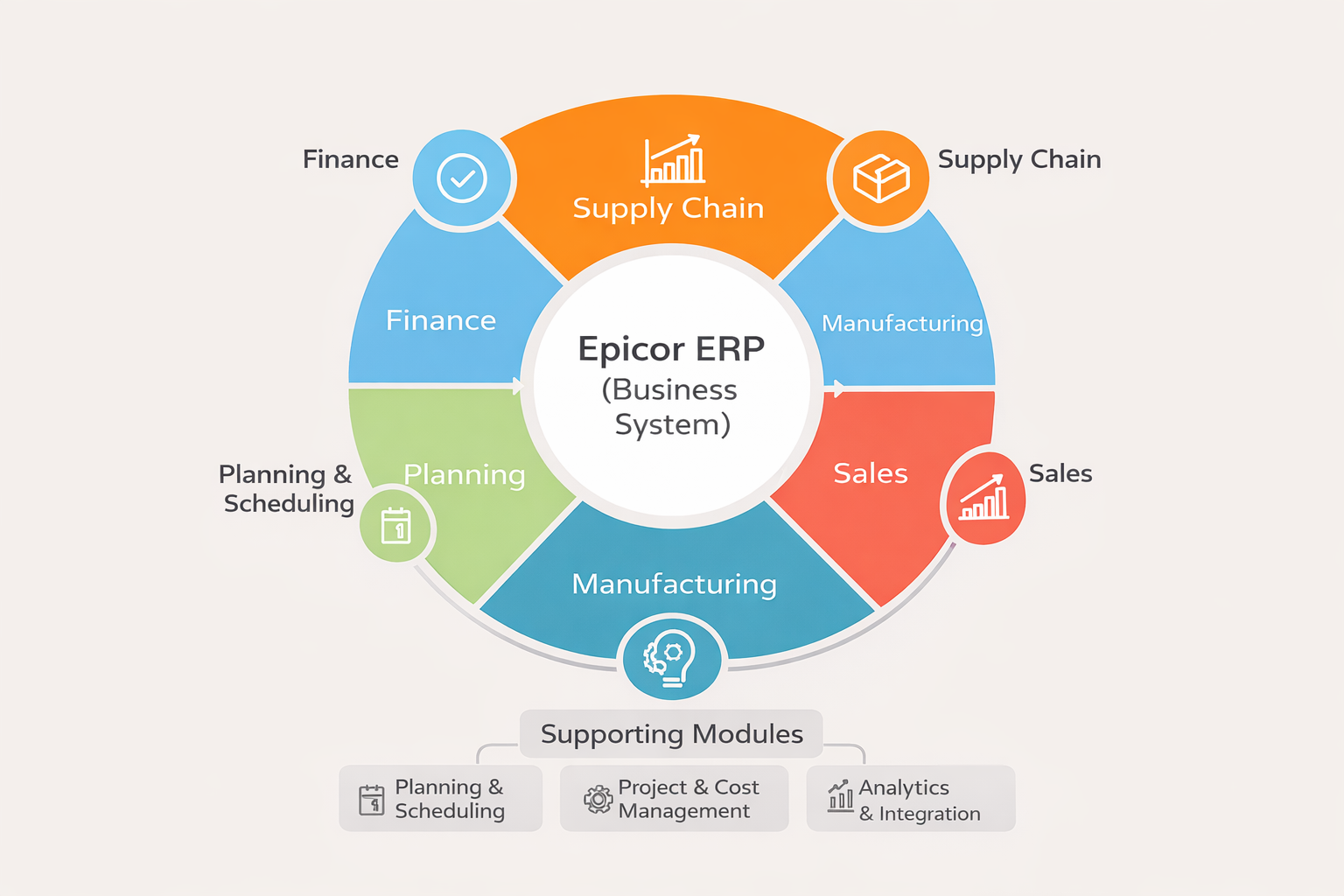
I see Epicor ERP not as a single large ERP system that fixes everything at once, but as a group of connected building blocks. Each module—finance, supply chain, manufacturing, planning—handles a specific task in the business. When we introduce these parts carefully, Epicor ERP helps teams work together better. Data becomes clearer across departments, and decision-making improves.
What I’ve also noticed, again and again, is that ERP software success has very little to do with how powerful the system is—and a lot to do with how clearly leaders understand what they are implementing.
The real strength of ERP lies not in features, but in clarity of intent.
In my opinion, leadership alignment around Epicor ERP modules is one of the most underestimated success factors in Epicor ERP projects. I’ve seen companies struggle not because Epicor ERP software was too complex, but because everything was turned on at once, without enough readiness on the ground. Some modules were essential from day one. Others could have waited. A few needed much more preparation than originally expected.
When leaders take the time to decide what to implement now, what to postpone, and what to approach carefully, the entire Epicor ERP implementation feels calmer and more controlled. Teams adapt better. Resistance drops. The ERP system starts supporting the business instead of disrupting it.
From what I’ve experienced over the years, Epicor ERP delivers its best results when it’s treated not as a one-time IT rollout, but as a living operating system—one that grows step by step with the organization.
Why CEOs Must Understand Modules (Without Becoming Technical)
ERP modules are not IT components in my experience. I’ve come to see them as clear reflections of how a business takes responsibility for its work. Each module represents a real business function, owned by real people, with real accountability.
Every module ultimately addresses two fundamental questions: Who truly owns this segment of the business? And how consistently and disciplined is it being executed daily?
Core Financial Modules
- General Ledger: the backbone of financial truth
- Accounts Payable and Receivable: cash discipline
- Fixed Assets: capital control
- Budgeting and financial reporting
Supply Chain Modules
- Inventory management
- Purchasing and supplier control
- Warehouse management
These modules play a crucial role in enhancing cash flow, optimizing working capital, and improving delivery reliability.
Manufacturing Modules
- Bill of Materials (BOM)
- Routings and operations
- Production tracking
- Job costing and variance analysis
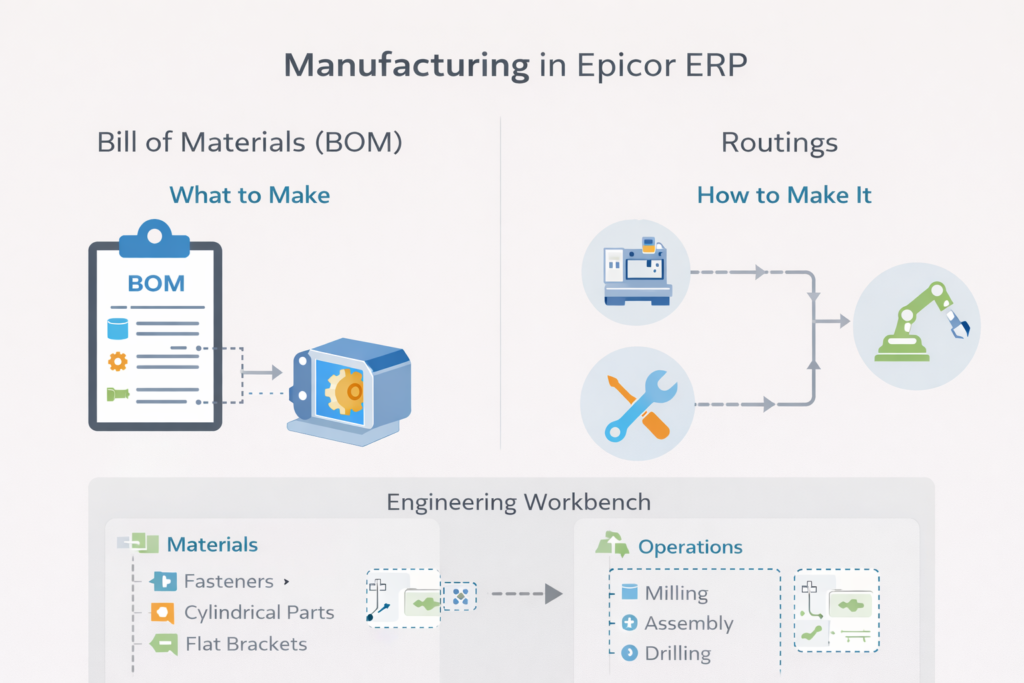
Manufacturing modules offer great potential, but they require careful attention and discipline to achieve accurate results. By maintaining a strong focus on best practices, we can ensure that our outcomes are reliable and beneficial.
Sales and Customer Modules
- Order management
- Pricing and discount control
- Customer credit and compliance
These are the main modules that form the foundation of Epicor ERP. The idea here is not to explain every module in detail or go into technical depth. This overview is meant to help you understand how the system is structured and what role each module plays in running a business.
Whereas the sections below cover additional supporting modules, they are included to show how the core modules are strengthened and connected to complete the full ERP cycle. Once this big picture is clear, it becomes much easier to understand the details later and decide what to implement and when.
Completing the Circle: What Often Gets Missed
Over the years, I’ve realized that focusing only on core ERP modules doesn’t give the full picture. In practice, Epicor ERP works best when the supporting modules are also taken seriously. These are often overlooked early on, but they quietly decide whether the system feels stable or stressful later.
Planning and Scheduling: Bringing Reality into the Plan
Beyond basic planning, modules like MRP and capacity planning help teams plan based on what the business can actually deliver—not just on targets. When this is done well, firefighting reduces and commitments become more reliable.
Projects and Cost Visibility: Seeing the Real Margins
Project and costing modules help leadership see whether work is truly profitable, not just busy. Without this clarity, margins often erode quietly in the background.
Reporting and Governance: Keeping ERP Healthy
Dashboards, approvals, and workflows may not be exciting, but they keep the system disciplined. They help leaders spot issues early and prevent shortcuts from weakening the ERP over time.
CEO Takeaway
Modules are not simply checkboxes. Each one requires a sense of ownership, discipline, and strong leadership to be effectively implemented.
From what I’ve seen, Epicor ERP is not just software—it’s a way of running the business. Core modules run operations, supporting modules protect them, and visibility modules guide decisions. When introduced in the right order and owned by the right people, ERP becomes a strength, not a struggle.
Important Note:
This article is published for educational and informational purposes only. It reflects general industry experience and does not constitute legal, financial, or implementation advice.
ERP outcomes vary significantly based on organizational readiness, process maturity, data discipline, and leadership involvement.
Readers should evaluate their own business context and consult qualified professionals before making ERP selection or implementation decisions.
All product names, trademarks, and company names mentioned are the property of their respective owners and are used solely for identification and educational discussion.
Next Read
Epicor vs Generic ERP – The Real Difference
How Companies Actually Select Epicor ERP